


Low purchase price or lower lifecycle costs?

When discussing a new machine investment with a customer, the first step is to determine the level of equipment and functionality needed. From there, we can start evaluating the overall package and the investment required. Naturally, purchase price is an important factor in every buying decision, and asking questions about it is both sensible and necessary. What is easy to overlook, however, is that the purchase price tells only part of the story.
For nearly 17 years, I’ve had a front-row seat to customers’ equipment purchasing decisions. Along the way, I have learned that the best investments are seldom those with the lowest purchase price. What ultimately matters is the value a machine delivers throughout its lifecycle and the savings it generates over time.
The price tag tells only half the story
The real costs of an environmental maintenance machine only become apparent once it gets to work.
Fuel consumption, maintenance requirements, operating hours, labour costs and resale value all have an impact on the total profitability of the investment. This is exactly what we speak of when looking at the Total Cost of Ownership (TCO), the true cost of owning and operating a machine throughout its lifecycle.
Many customers are already using their own Excel spreadsheets to calculate the real cost of their machines and the savings that can be achieved. At Wille Machines, we wanted to simplify that process by providing clear, data-driven insights. That’s why we developed the Wille® TCO calculator – a tool that helps customers assess the true cost of different machine options in their own operations.
Versatility drives efficiency
When comparing machines, discussions often centre around price, size and power. While all these factors are important, one question deserves equal attention:
How much work can one machine accomplish?
This is where the benefits of a truly versatile environmental maintenance machine become clear. When one machine can perform multiple tasks across different seasons, utilisation rates increase and the investment delivers greater value.
One good example is winter maintenance. If snow ploughing and sanding can be carried out in a single pass using two attachments, considerable time and fuel can be saved. If the operator instead has to return to the depot to switch attachments, the same route may effectively need to be driven twice.
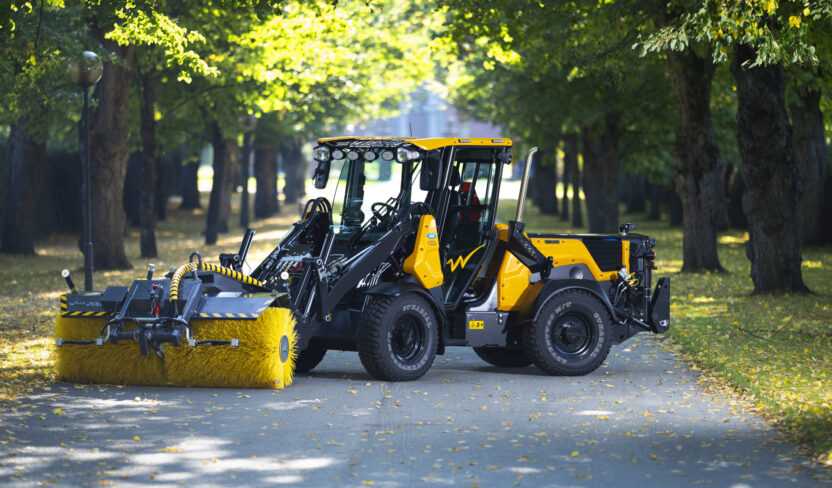
Even when ploughing and sanding are carried out as separate operations, the right machine and attachment configuration can significantly improve efficiency. A Wille machine can be equipped with one spreader at the front and another at the rear or on top of the engine cover. This increases carrying capacity substantially, allowing transport of at least twice as much sand as a machine using only a single spreader. In practice, this means longer routes can be completed without interruptions for refilling.
Even seemingly small differences can have a surprisingly big impact on costs, especially when viewed over the machine’s entire lifecycle.
A practical tool for better decision-making
The Wille TCO calculator evaluates key factors including capital costs, operator wages, maintenance expenses, fuel consumption and CO₂ emissions. Insurance costs are not included in the calculation, although registering a Wille machine as a tractor may provide savings in that area as well.
The purchase price used in the calculator is provided as an indicative starting point. Every parameter can be adjusted to reflect the customer’s own operating conditions and requirements, ensuring that the results remain relevant to real-world operations.
The feedback we’ve received suggests the calculator focuses on exactly the issues decision-makers consider when evaluating machinery investments. Discussing total costs and using the lifecycle cost calculator often leads to new insights and challenges long-held assumptions. I encourage customers to try the calculator when they want to take a serious look at their operations and explore where greater efficiencies can be achieved.
Questions may naturally arise during this process, and Wille sales representatives are always available to help interpret the TCO calculation results and discuss different options. When it comes to fuel consumption, for example, I’ve occasionally heard people question whether the difference can really be as large as the calculations suggest. Fortunately, there’s no need to rely on guesswork or gut feeling here: Wille Smart Link continuously collects data on machine usage, including fuel consumption and CO₂ emissions, allowing costs to be assessed based on real-world data. As operating hours accumulate over the years, even small differences in fuel consumption can add up to significant savings.
The better the overall solution, the greater the savings
While the TCO calculator often demonstrates that a machine with a higher purchase price can ultimately be the more economical choice, I wouldn’t expect anyone to make an investment decision based solely on a single calculation.
The purpose of the calculator is to support better decision-making by providing a broader perspective. It helps identify where costs are created over the long term and which factors have the greatest impact on operational efficiency and profitability.
A cheaper machine may be the less expensive option upfront, but over time the equation can change completely. When utilisation rates, fuel and labour costs, and maintenance are all taken into account, the overall cost picture is often very different from what it first appeared to be.
Ultimately, it comes down to choosing the machine that delivers the best long-term value. It rarely makes sense to purchase a new machine for every individual task when attachments can do the job. A single Wille can be used for a wide variety of applications, and that versatility is one of the key reasons it performs so well in TCO comparisons. The more tasks and seasons the same machine is used for, the higher its utilisation rate becomes, with the resulting savings reflected in the machine’s lifecycle costs.
Note: the Wille TCO calculator is currently available only in Finnish, but it will be translated into other languages in the near future.